Editable Word document
Subject Access Request template
Use this ready-to-edit letter to request personal data and children’s social care records, including MASH material, case files, communications, audit trails and document metadata.
Download the SAR template (.docx)Campaign resources
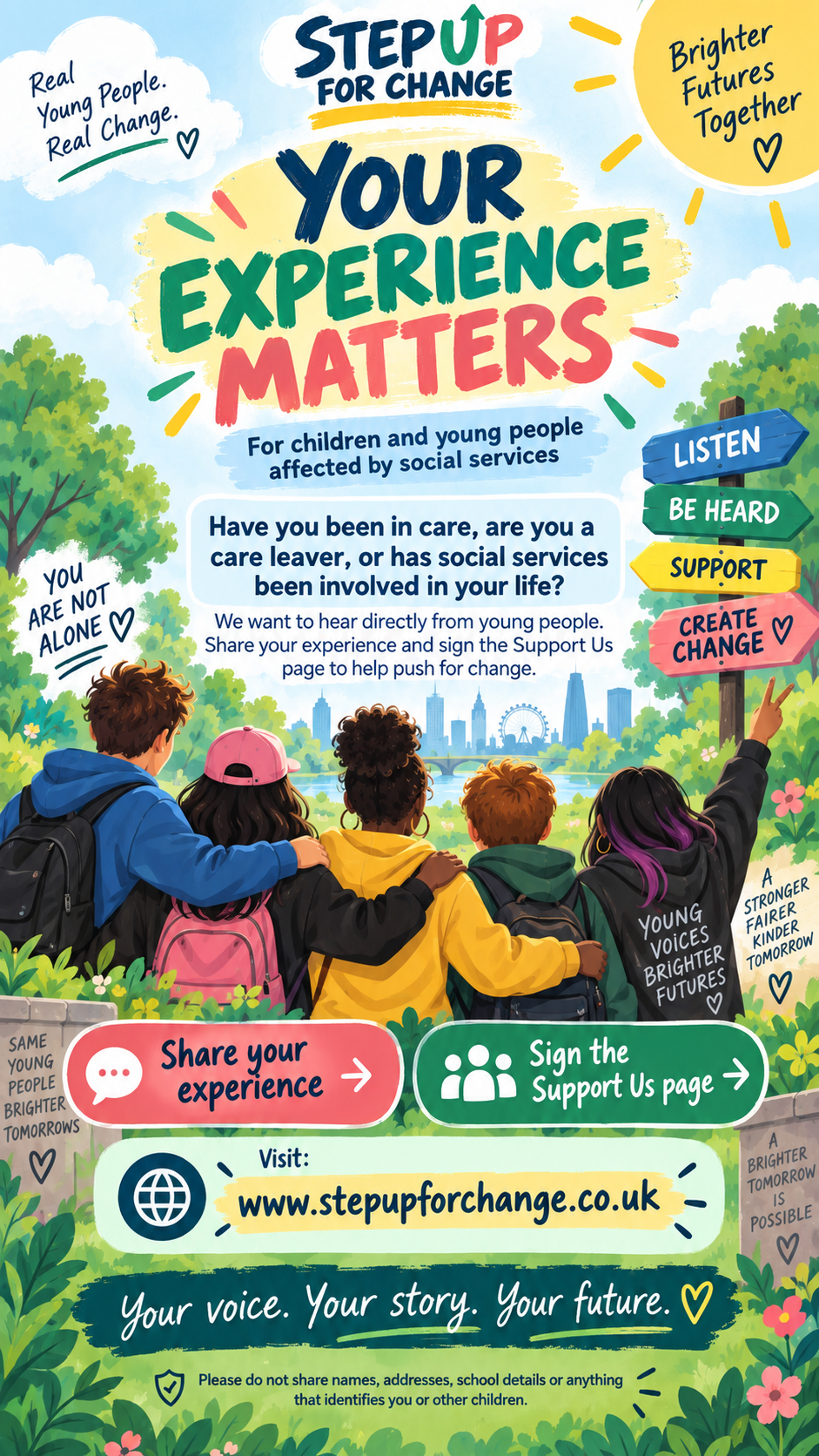
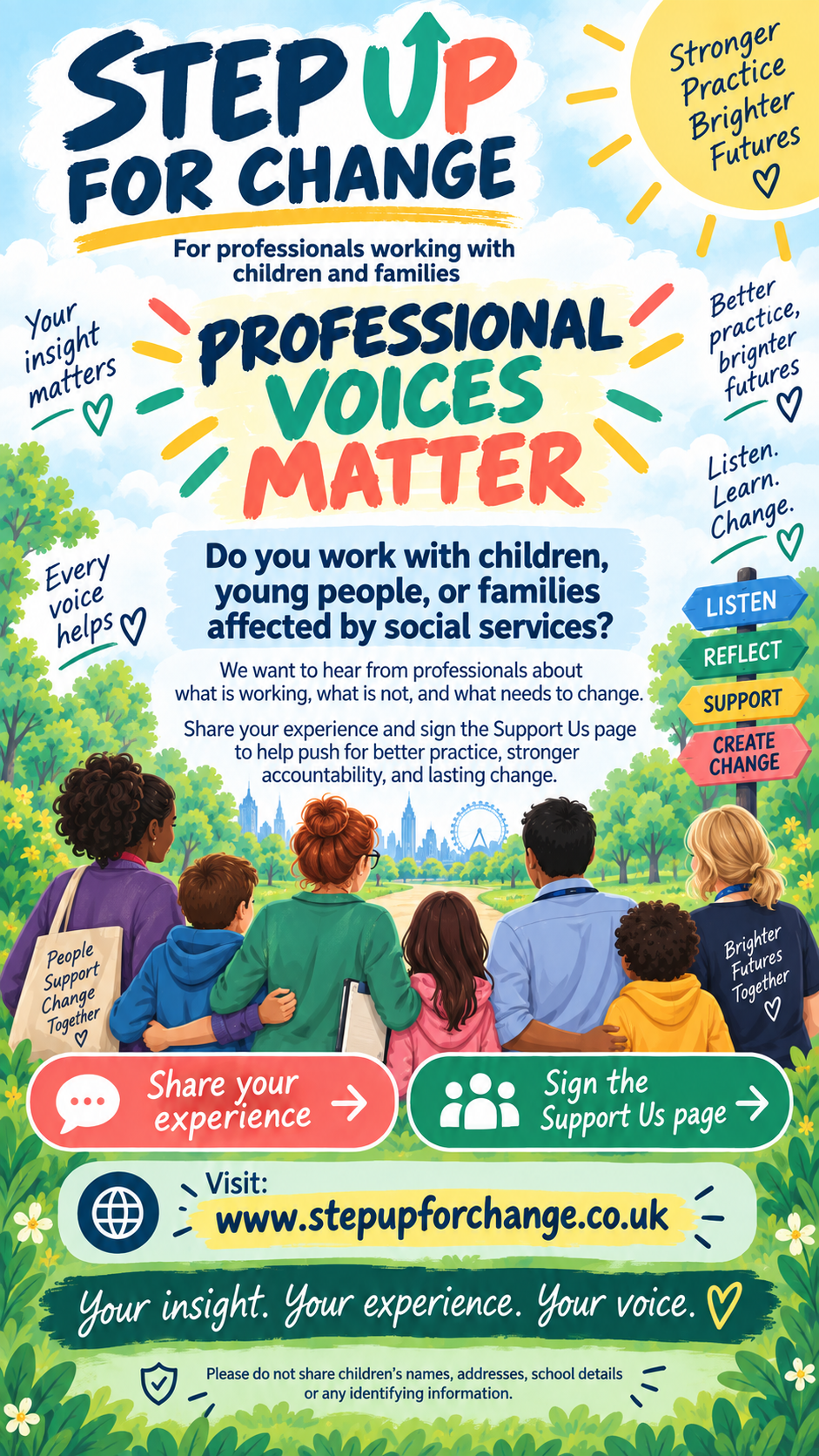
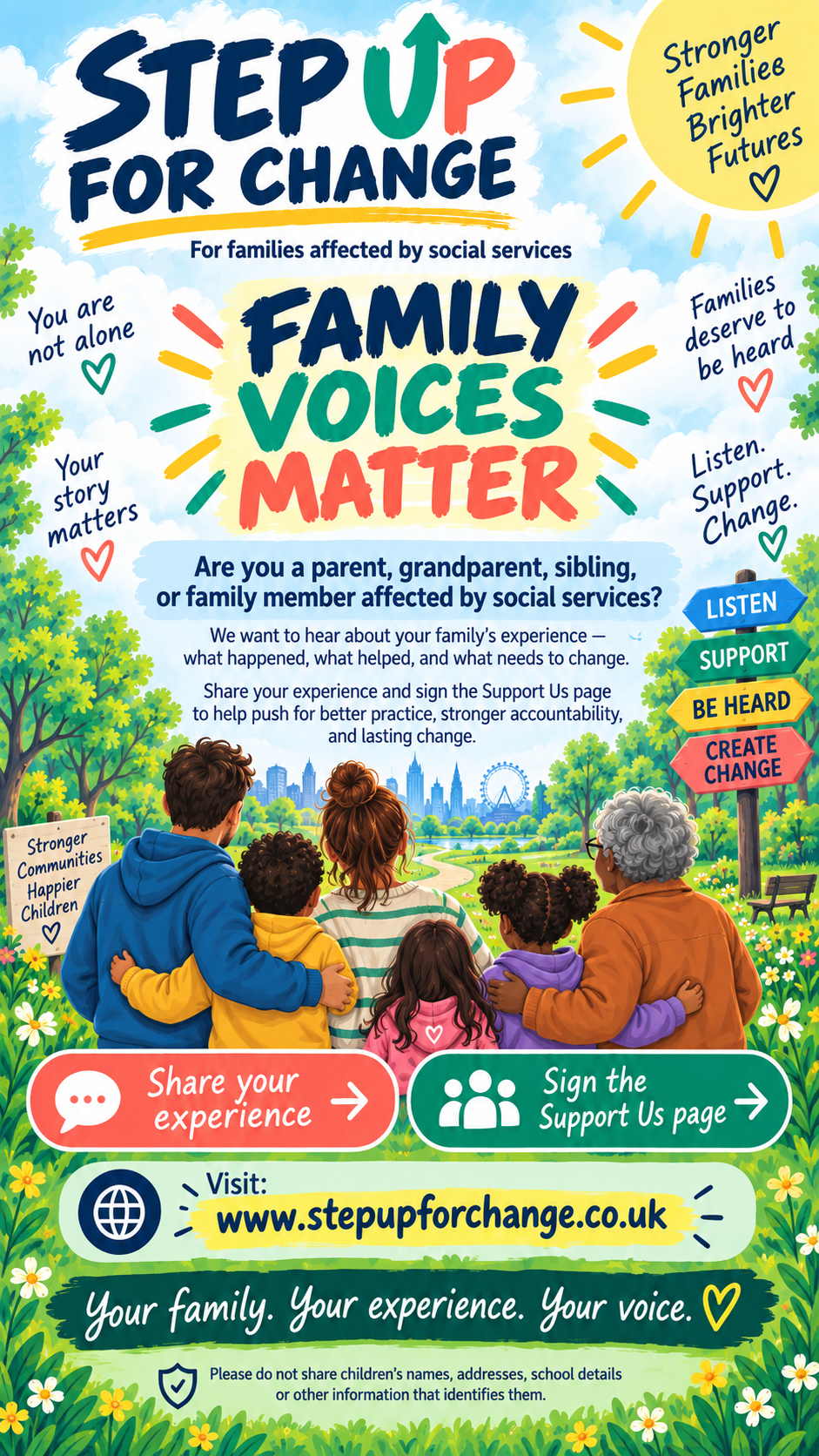
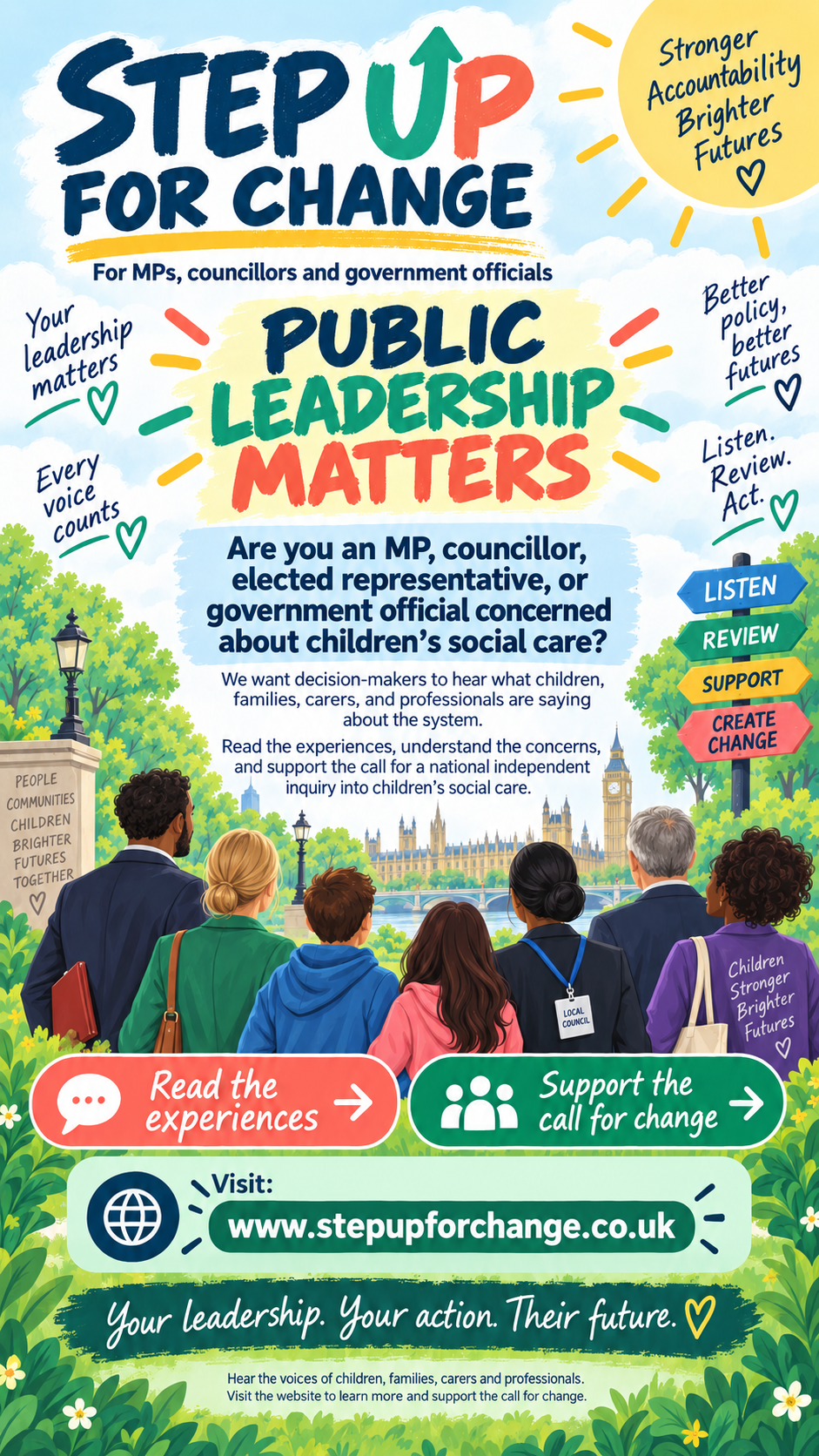
Campaign posters to share
Download ready-made posters to share on social media and help spread the message.
Includes 5 shareable campaign posters
Ideal for Facebook, Instagram and community sharing.

Guidance by nation
Routes by nation
Choose the country where the service is based. Each folder contains the relevant routes, regulators and official sources.
England
Council concerns and children’s services
Routes for getting help, making a complaint or escalating concerns
This practical England-focused guide explains 48 internal and external routes. Different organisations have different powers, so choose the route that matches the result you need.
Is a child in immediate danger?
Call 999. If there is no immediate danger, contact the council’s children’s services or emergency duty team. Police non-emergencies can be reported on 101.
Quick route finder
Choose the closest match, then read the full route before acting.
- Immediate danger or risk to a child
- Start or escalate a council complaint
- Council complaint process has finished
- Personal data, records or a delayed SAR
- Serious concerns about a social worker's fitness to practise
- A child needs independent help or advocacy
- A binding legal remedy may be needed
- Build a clear evidence trail
Before you begin: keep correspondence factual, save copies and dates, state the outcome you want, and avoid publishing children’s names, addresses, school details, case numbers or court documents.
This is general information, not legal advice. It applies to England; arrangements differ in Scotland, Wales and Northern Ireland. Rules, remits and deadlines can change, and court deadlines can be short. Check the linked official guidance or get independent legal advice for your circumstances.
Guide reviewed 10 September 2026.
Start with your council
Start with Children's Services — but escalate up the management chain
Depending on the problem, you can approach:
- Allocated Social Worker
- Senior Social Worker
- Team Manager
- Service Manager
- Head of Service
- Assistant/Deputy Director
- Director of Children's Services
Do not assume your complaint has reached senior management simply because you sent it to a generic Children's Services inbox.
Ask for the name and position of the officer making the decision.
Children's statutory complaints procedure
Some Children's Services complaints must be dealt with under the special statutory procedure created for children's social care.
It can include complaints relating to children in need, children in care, fostering, adoption support and special guardianship.
The process can involve:
Stage 1 — Local Resolution
The council attempts to resolve the complaint.
Stage 2 — Independent Investigation
This normally involves:
- an Independent Investigator
- an Independent Person overseeing the investigation
Stage 3 — Independent Review Panel
A panel reviews how the Stage 2 complaint was dealt with.
Not every Children's Services complaint falls under this statutory procedure, so ask the council in writing which complaints procedure it is using and why.
If the statutory procedure applies, councils cannot simply invent their own replacement process.
Official guidance: Children's social care complaints guidance (GOV.UK) ↗
If the complaint process is stalling
Do not automatically assume you must wait forever.
The Local Government and Social Care Ombudsman (LGSCO) says it can sometimes consider a complaint before the statutory procedure has finished where there have been significant delays.
Keep records of:
- dates
- unanswered emails
- extensions
- missed deadlines
- cancelled meetings
- changes of investigator
- failures to provide decisions
- failures to progress between complaint stages
A detailed chronology can become extremely important.
Independent Reviewing Officer — IRO
If your child is looked after by the local authority, there should normally be an Independent Reviewing Officer involved.
Concerns can be raised with:
- the IRO
- the IRO's manager
- the IRO service manager
If you believe the care plan is not being followed, contact arrangements are not being properly considered, reviews are ineffective or the authority is failing to carry out agreed actions, put this to the IRO in writing.
Director of Children's Services
Every upper-tier/local authority responsible for Children's Social Care has a Director of Children's Services (DCS).
This is one of the most senior statutory children's-services positions within the authority.
For serious concerns involving multiple teams, management failures or widespread practice issues, escalate beyond the individual social-work team.
Council chief executive
You can escalate serious administrative or corporate concerns to the council's Chief Executive / Head of Paid Service.
This is particularly relevant where the issue is no longer just about one social worker but appears to involve:
- multiple departments
- senior management
- repeated process failure
- institutional governance
- failure to implement remedies
- breakdown of internal accountability
This is not a replacement for the statutory complaint process, but senior leadership should be made aware of serious corporate failures.
The council's monitoring officer
This is one of the least-known escalation routes.
Every council has a Monitoring Officer.
They have important responsibilities concerning:
- legality
- the council constitution
- decision-making
- governance
- probity
- ethics
- serious maladministration within their statutory remit
The Monitoring Officer is not an appeal body for ordinary social-work decisions.
But where the concern involves serious governance, unlawful decision-making or failures in the council's constitutional arrangements, this may be an appropriate route.
Your local councillor
Your ward councillor can undertake casework and raise concerns with officers on your behalf.
You can also approach other councillors where their particular council role is relevant.
Find your councillors through your council website.
Cabinet member / executive member for children
Most councils have a senior elected councillor whose portfolio includes:
- Children's Services
- Children and Families
- Children's Social Care
- Children and Young People
Titles vary between councils.
They provide political oversight of the service.
They usually cannot personally overturn an individual social-work decision, but serious service failures should not automatically be kept away from the elected member responsible for the portfolio.
Leader of the council
For serious council-wide governance concerns, you can write to the Leader of the Council.
Again, this is not an alternative appeals process, but elected leadership can be made aware of evidence alleging systemic failures.
Opposition councillors
Do not assume you can only contact the political party running the council.
You can contact:
- Leader of the Opposition
- opposition children's-services spokespersons
- other elected councillors
They may be able to raise questions, request scrutiny or challenge the administration politically.
Overview and scrutiny committee
Find your council's committee responsible for scrutiny of Children's Services.
It may be called:
- Children and Families Scrutiny Committee
- Children and Adults Scrutiny Committee
- People Scrutiny Committee
- Children and Young People Scrutiny Committee
Scrutiny normally cannot decide your individual complaint or overturn a social-work decision.
However, scrutiny committees exist to hold executive decision-makers to account and can examine evidence of wider service or systemic problems.
If numerous families are experiencing the same problem, scrutiny becomes especially relevant.
Full council / public questions
Many councils allow residents to submit:
- questions to Full Council
- petitions
- questions to cabinet members
- representations to committees
Check your council constitution.
This will not resolve every individual case, but it can put an issue into the public democratic record.
Standards / governance committee
Where concerns relate to:
- councillor conduct
- governance arrangements
- ethical standards
- constitutional matters
check the council's Standards, Audit, Governance or Ethics Committee arrangements.
Complaints against councillors normally follow a separate Code of Conduct procedure.
Records, data and evidence
Data Protection Officer — DPO
Children's Services handles extremely sensitive personal information.
If the concern involves:
- unlawful disclosure
- personal information sent to the wrong person
- insecure email accounts
- missing information
- subject access requests
- inaccurate personal data
- records management
- data security
contact the council's Data Protection Officer.
Information Commissioner's Office — ICO
If the council does not properly resolve a data-protection complaint, you can complain to the Information Commissioner's Office.
The ICO deals with information-rights and data-protection law.
It does not decide whether a social worker's safeguarding assessment was correct.
Keep the two issues separate:
social-care complaint → social-care routes
personal-data problem → DPO/ICO
Official guidance: Make a data protection complaint (ICO) ↗
Subject Access Request — SAR
This is not an escalation body, but it can be extremely important.
You can request personal information held about you under data-protection law, subject to applicable exemptions.
Evidence can be very difficult to challenge when you do not know what has actually been recorded.
Keep:
- emails
- assessments
- reports
- complaint correspondence
- meeting records
- contact decisions
- review documents
- chronology entries
- screenshots
- letters
Do not rely solely on telephone conversations.
Official guidance: Subject access requests (ICO) ↗
Request correction / challenge inaccurate records
If you believe Children's Services records contain inaccurate personal data, put the challenge in writing.
Data-protection law does not mean every professional opinion you disagree with must automatically be deleted.
But factual inaccuracies should be clearly identified and challenged.
Where disagreement remains, ask what mechanism exists for your correction, disagreement or supplementary statement to be recorded.
Keep a master evidence log
This may be one of the most important things you do.
Create a chronology containing:
DATE → PERSON → EVENT → EVIDENCE → RESPONSE → OUTCOME
Keep copies of everything.
When something happens verbally, follow it with an email:
"Further to our telephone conversation today, my understanding is..."
Five months later, that email may be the only reliable record of what was said.
External oversight and safeguarding
Local Government and Social Care Ombudsman — LGSCO
The LGSCO investigates complaints involving things such as:
- maladministration
- service failure
- procedural fault
- failures in complaint handling
Normally you should first give the council an opportunity to deal with the complaint.
For qualifying Children's Services complaints there is a three-stage statutory process.
However, the Ombudsman confirms that significant delays can sometimes justify approaching it before all stages have finished.
The Ombudsman generally cannot:
- overturn a court judgment
- investigate something already determined by a court simply because you disagree with it
- act as an appeal court
Official guidance: How to complain (LGSCO) ↗
Ofsted
Ofsted inspects local authority Children's Services.
Ofsted is not an alternative Ombudsman for your individual complaint.
However, you can share information about Children's Social Care with Ofsted, particularly where there may be:
- wider safeguarding failures
- poor-quality practice
- systemic problems
- repeated concerns
- whistleblowing information
- patterns affecting multiple children
Ofsted expressly says complaints and whistleblowing concerns suggesting a pattern of concerns can form part of the intelligence it considers when deciding how to inspect an authority.
Think of this as:
Regulatory intelligence
rather than an appeal against your individual social worker.
Official guidance: Raise concerns about children's social care (Ofsted) ↗
Social Work England
Social Work England regulates individual registered social workers.
It can consider serious concerns about a social worker's fitness to practise.
Examples can include serious concerns involving:
- professional boundaries
- confidentiality
- dishonesty or fraud
- serious misconduct
- unsafe practice
But Social Work England does not regulate the council itself and cannot overturn:
- care proceedings
- council decisions
- contact decisions
- family-court judgments
A disagreement with a social worker is not automatically a fitness-to-practise matter.
Serious professional-conduct evidence is what matters.
Official guidance: Raise a concern about a social worker (Social Work England) ↗
Local Authority Designated Officer — LADO
This route is frequently misunderstood.
The LADO deals with allegations concerning people who work or volunteer with children.
Under current safeguarding guidance, allegations-management arrangements should cover situations where someone working with children may have:
- harmed a child
- possibly committed an offence involving a child
- behaved in a way suggesting they pose a risk of harm
- behaved in a way suggesting they may not be suitable to work with children
This is not the route for an ordinary complaint about poor service.
Different councils also have different arrangements for whether members of the public contact the LADO directly or the allegation first goes through the employer/safeguarding route.
Search:
"[your council] LADO"
Local Safeguarding Children Partnership
Every area has multi-agency safeguarding arrangements.
The three statutory safeguarding partners are:
- the Local Authority
- the NHS Integrated Care Board
- the Police
This is important.
Safeguarding is not solely controlled by Children's Services.
Where the concern involves wider multi-agency safeguarding arrangements, look for your area's:
Local Safeguarding Children Partnership
and its escalation arrangements.
Current legislation continues to place joint safeguarding responsibility across the local authority, ICB and police.
Independent scrutineer of the safeguarding partnership
Many safeguarding partnerships have an Independent Scrutineer or equivalent independent scrutiny arrangements.
Their role is concerned with examining the effectiveness of the multi-agency safeguarding system.
Search:
"[YOUR AREA] Safeguarding Children Partnership Independent Scrutineer"
This may be particularly relevant where the concern is about whether agencies are effectively challenging one another.
NHS Integrated Care Board — ICB
The local ICB is one of the statutory safeguarding partners.
If Children's Services concerns also involve:
- health safeguarding
- paediatric services
- health assessments
- mental health provision
- failures of multi-agency working
consider the relevant NHS safeguarding and complaints routes as well.
Do not assume every safeguarding concern has to be sent back into the council.
Police — safeguarding partner
Police are also one of the three statutory safeguarding partners.
If you are contacting police about safeguarding-system governance, make that clear.
This is different from reporting an alleged criminal offence.
Police — suspected criminal conduct
If you genuinely have evidence potentially indicating a criminal offence, report the underlying facts to the police.
Do not simply write:
"Children's Services are corrupt."
Explain:
- who did what
- when it happened
- what evidence exists
- why you believe it was deliberate
- what possible offence you believe requires assessment
Poor practice, maladministration and negligence are not automatically crimes.
Advice, advocacy and family support
Children's Commissioner for England — Help at Hand
The Children's Commissioner's Help at Hand service supports children who:
- are in care
- have a social worker
- are working with social services
- live away from home
- are care leavers under 25
They can provide independent advice and make representations.
Serious unresolved cases can potentially be escalated to Director level within public services.
The service is primarily child-led, so parents should understand that the Commissioner's office is not another complaints regulator.
Freephone:
0800 528 0731
Official guidance: Help at Hand (Children's Commissioner) ↗
Independent advocate
Children and young people may be entitled to independent advocacy in various circumstances.
Ask:
"Is my child entitled to an independent advocate?"
An advocate can help a child:
- understand their rights
- express their wishes and feelings
- make a complaint
- participate in meetings
- challenge decisions
Do not assume the social worker is the only person through whom the child's views can be communicated.
Coram Voice
Coram Voice provides advocacy and support to care-experienced children and young people.
This can be particularly useful for:
- looked-after children
- care leavers
- young people wanting to complain
- young people who feel their views are not being heard
Family Rights Group
Family Rights Group provides independent advice to parents, relatives and kinship carers involved with Children's Services in England.
Their advice service can help families understand:
- Children's Services processes
- child-protection procedures
- pre-proceedings
- care proceedings
- family-and-friends care
- legal options
Advice line:
0808 801 0366
Their advice is independent of the local authority.
Coram Child Law Advice
Coram Child Law Advice provides information about child and family law, including local-authority involvement with families.
The House of Commons Library specifically identifies both Family Rights Group and Coram Child Law Advice as potential specialist sources of assistance for families complaining about Children's Services.
Foster Carers — Independent Review Mechanism
Prospective and existing foster carers should know about the:
Independent Review Mechanism – IRM
Certain qualifying fostering decisions can be independently reviewed.
This can include some decisions relating to:
- suitability to foster
- approval
- terms of approval
The IRM makes a recommendation; the final decision remains with the fostering provider.
Adoption — Independent Review Mechanism
The IRM also deals with certain qualifying adoption decisions, including:
- suitability to adopt
- certain adoption-record disclosure decisions
Again, it is a specialist review mechanism rather than a general complaints body.
Government, councillors and Parliament
Department for Education — DfE
The Department for Education is the central government department responsible for Children's Social Care policy.
It is not normally the appeals body for an individual council complaint — official DfE guidance directs ordinary local-authority Children's Services complaints through the council and then the relevant Ombudsman.
However, evidence of serious systemic Children's Services issues, national policy failures or matters relevant to local-authority improvement/intervention can still be brought to central government's attention.
Look for:
- Minister for Children and Families
- Secretary of State for Education
- relevant Children's Social Care teams within DfE
Use the role, rather than relying on a person's name, because ministers change.
Official guidance: Department for Education complaints procedure (GOV.UK) ↗
Ministry of Housing, Communities and Local Government — MHCLG
This route relates to the governance of the council itself, not whether one social worker made the correct decision.
MHCLG oversees the local-government Best Value framework.
Central government has powers ranging from support and monitoring to statutory intervention where serious council-wide governance failures exist.
For very serious systemic governance concerns, look for:
Local Government Stewardship and Interventions
Again:
This is not another Stage 4 complaint process.
It is potentially relevant where evidence raises questions about the functioning and governance of the authority itself.
If your council is already under government intervention
This is extremely important.
Check whether your council is subject to:
- Commissioners
- Ministerial Envoys
- Best Value Inspectors
- a Best Value Notice
- statutory directions
- another formal government improvement intervention
If it is, identify the appointed Commissioners, Envoys or Inspectors.
These people exist specifically because concerns have already arisen about the council's ability to meet required governance standards.
The Government maintains a public list of current and previous statutory Best Value interventions.
Search:
"[YOUR COUNCIL] statutory intervention GOV.UK"
Your Member of Parliament — MP
Your constituency MP can:
- make representations
- contact the council
- write to ministers
- approach government departments
- raise systemic concerns
- assist with certain Parliamentary Ombudsman referrals
An MP cannot overturn a Family Court decision.
But they can be an important escalation route where public bodies are failing to engage.
House of Commons Education Committee
The Education Committee scrutinises the Department for Education and matters affecting children.
It does not investigate individual family complaints.
However, committees sometimes invite evidence when conducting inquiries.
Systemic evidence affecting large numbers of families may therefore be relevant to future parliamentary inquiries.
House of Commons Housing, Communities and Local Government Committee
This committee scrutinises central government's work relating to local government.
Again:
It is not an individual complaint tribunal.
But evidence concerning widespread council governance problems may be relevant to parliamentary scrutiny or inquiries.
Parliamentary and Health Service Ombudsman — PHSO
Do not confuse this with the LGSCO.
LGSCO → local councils
PHSO → UK government departments and certain other public bodies
If you complain to DfE, MHCLG or another government department and exhaust its complaint process, a complaint about the government department's own maladministration may potentially go to the PHSO.
For UK-government complaints, the PHSO currently requires an MP to refer the complaint.
Legal routes and court challenges
Children's Law / Family Law solicitor
Complaints cannot solve everything.
If the issue concerns:
- care proceedings
- contact with a child in care
- discharge of a care order
- placement orders
- adoption
- parental responsibility
- Family Court decisions
you may need a specialist children's-law solicitor.
A complaints body cannot simply overturn a Family Court judgment.
Public Law / Community Care solicitor
This is another route people often discover far too late.
Where the complaint concerns whether a council has:
- failed to perform a statutory duty
- acted unlawfully
- followed an unlawful policy
- failed to follow proper procedure
- made an irrational public-law decision
- unlawfully interfered with rights
seek advice from a solicitor specialising in:
Public Law / Community Care / Judicial Review
Do this quickly.
Judicial Review has short time limits. Proceedings normally have to be brought promptly and generally within three months of the decision being challenged.
Do not assume that making a council complaint automatically stops legal time limits.
Family Court
Sometimes the only body capable of giving the remedy you actually need is the court.
For example, where the real dispute concerns:
- existing care orders
- parental contact
- placement orders
- discharge applications
- ongoing proceedings
get specialist legal advice about the appropriate Family Court application.
Complaints procedures and court proceedings serve completely different purposes.
High Court — judicial review
Judicial Review examines the lawfulness of public-body decision-making.
It is not simply another opportunity to argue that Children's Services made the wrong judgment.
Specialist legal advice is essential.
Potential public-law challenges can involve:
- illegality
- procedural unfairness
- irrationality
- breach of statutory duty
- human-rights issues
Legal deadlines can be extremely short.
Official guidance: Judicial review procedure (Civil Procedure Rules Part 54) ↗
High Court — challenging an ombudsman decision
There is not normally an ordinary appeal against an LGSCO decision.
Where someone believes the Ombudsman's decision itself is legally defective, Judicial Review may potentially be available.
Again, specialist legal advice is required.
Immediate risk to a child
Immediate risk to a child
If a child is at immediate risk of serious harm:
999 – Police
For non-emergency crime concerns:
101 / your police force's reporting system
For safeguarding concerns, contact the appropriate Children's Social Care safeguarding service as well.
Do not wait for a complaint investigation where there is an immediate safety issue.
The biggest thing to remember
These organisations do different jobs.
Do not send exactly the same complaint to everybody and expect the same result.
Ask yourself:
Is this about poor service or maladministration?
→ Council complaints / LGSCO
Is this serious misconduct by an individual social worker?
→ Employer / Social Work England
Is this about personal-data handling?
→ DPO / ICO
Is this an allegation that someone working with children may have harmed a child?
→ safeguarding/employer/LADO route
Is this a systemic safeguarding problem?
→ Safeguarding Partnership / Ofsted
Is this systemic council governance failure?
→ Monitoring Officer / Scrutiny / elected leadership / MHCLG
Is the council already under government intervention?
→ Find the Commissioners / Ministerial Envoys / Inspectors
Does the child need an independent voice?
→ IRO / independent advocacy / Children's Commissioner Help at Hand
Is this about a government department failing you?
→ Department complaint → MP → PHSO where applicable
Do you actually need a legally binding decision?
→ Specialist solicitor / Family Court / Public Law / Judicial Review
YOU ARE NOT LIMITED TO ONE GENERIC CHILDREN'S SERVICES COMPLAINTS INBOX.
There is an entire network of:
- statutory officers
- regulators
- ombudsmen
- safeguarding partners
- elected representatives
- scrutiny bodies
- central government departments
- advocates
- independent reviewers
- and courts
The correct route depends on what has happened and what remedy you actually need.
Save this.
Share it with parents, grandparents, kinship carers, foster carers, care leavers and young people involved with Children's Services.
A huge part of the battle is simply knowing where you are allowed to turn next.
This guide relates to England. Scotland, Wales and Northern Ireland have different systems. It is general information, not individual legal advice.
Wales
Start with the relevant local authority social services complaints procedure. Escalation, regulation and professional-conduct routes are different from England.
Welsh Government: social care and social-services complaints guidance
Use this official route for the relevant service or concern.
Open the official route ↗Public Services Ombudsman for Wales
Complaints about public services and independent care providers.
Open the official route ↗Care Inspectorate Wales
Regulation and inspection of social care and childcare.
Open the official route ↗Social Care Wales
Concerns about registered social-care professionals.
Open the official route ↗Children’s Commissioner for Wales
Use this official route for the relevant service or concern.
Open the official route ↗Information Commissioner’s Office
Data-protection concerns.
Open the official route ↗Senedd Cymru
Find and contact your Member of the Senedd.
Open the official route ↗Scotland
Start with the council or service provider. The Scottish Public Services Ombudsman is normally the final stage for unresolved public-service complaints.
Scottish Government: feedback and complaints guidance
Use this official route for the relevant service or concern.
Open the official route ↗Scottish Public Services Ombudsman
Use this official route for the relevant service or concern.
Open the official route ↗Care Inspectorate
Concerns about regulated care services.
Open the official route ↗Scottish Social Services Council
Concerns about registered workers.
Open the official route ↗Children and Young People’s Commissioner Scotland
Use this official route for the relevant service or concern.
Open the official route ↗Information Commissioner’s Office
Data-protection concerns.
Open the official route ↗Scottish Parliament
Find your MSP.
Open the official route ↗Northern Ireland
Children’s social care is delivered through Health and Social Care Trusts. Begin with the Trust’s complaints process; free independent support is available through the Patient and Client Council.
nidirect: how to complain or raise concerns about health and social care
Use this official route for the relevant service or concern.
Open the official route ↗Patient and Client Council
Help with questions, concerns and complaints.
Open the official route ↗Northern Ireland Public Services Ombudsman
Use this official route for the relevant service or concern.
Open the official route ↗Regulation and Quality Improvement Authority
Concerns which may inform inspection work.
Open the official route ↗Northern Ireland Social Care Council
Professional conduct and registration.
Open the official route ↗Northern Ireland Commissioner for Children and Young People
Use this official route for the relevant service or concern.
Open the official route ↗Information Commissioner’s Office
Data-protection concerns.
Open the official route ↗Northern Ireland Assembly
Find your MLA.
Open the official route ↗Republic of Ireland
For children’s social care, begin with Tusla. The Republic of Ireland has separate oversight bodies, courts and data-protection arrangements from the UK.
Tusla: feedback and complaints
Use this official route for the relevant service or concern.
Open the official route ↗Ombudsman for Children’s Office
Complaints about children’s public services.
Open the official route ↗HIQA
Concerns about health and social-care services.
Open the official route ↗Data Protection Commission
Personal-data complaints.
Open the official route ↗Office of the Ombudsman
Public-service complaints.
Open the official route ↗CORU
Regulation of social-care professionals.
Open the official route ↗Oireachtas
Find your TD or Senator.
Open the official route ↗Before using a route: keep dates and correspondence, explain the outcome you want, and check the official body’s current remit and time limits. This is general information, not legal advice.
Useful resource types
Looking for the right starting point?
Explore national routes or share your experience to help others and support change.